Focused Ultrasound for Essential Tremor & Parkinson's Tremor
Focused ultrasound is an incisionless treatment option for selected patients with medication-resistant essential tremor or Parkinson's tremor, using MRI-guided sound energy and real-time temperature monitoring to target the tremor circuit without an implanted device.
Focused ultrasound care pathway
From tremor evaluation to follow-up
Evaluation and options
Confirm the tremor diagnosis, severity, medication response, goals, and whether focused ultrasound, DBS, medication adjustment, or observation best fits.
Imaging planning
Review MRI and skull-related technical factors to confirm whether treatment is feasible.
Procedure and testing
Use MRI guidance to test the target, monitor tremor response and side effects, then deliver focused ultrasound energy to create the final lesion.
Follow-up
Track tremor control, balance, sensation, recovery, and longer-term treatment goals.
Incisionless option
Focused ultrasound uses MRI-guided sound energy rather than an implanted device.
Careful selection
Diagnosis, tremor pattern, imaging, skull characteristics, and goals determine whether it fits.
Option comparison
DBS, focused ultrasound, medication, and observation are compared around durability, adjustability, and risk.
Overview
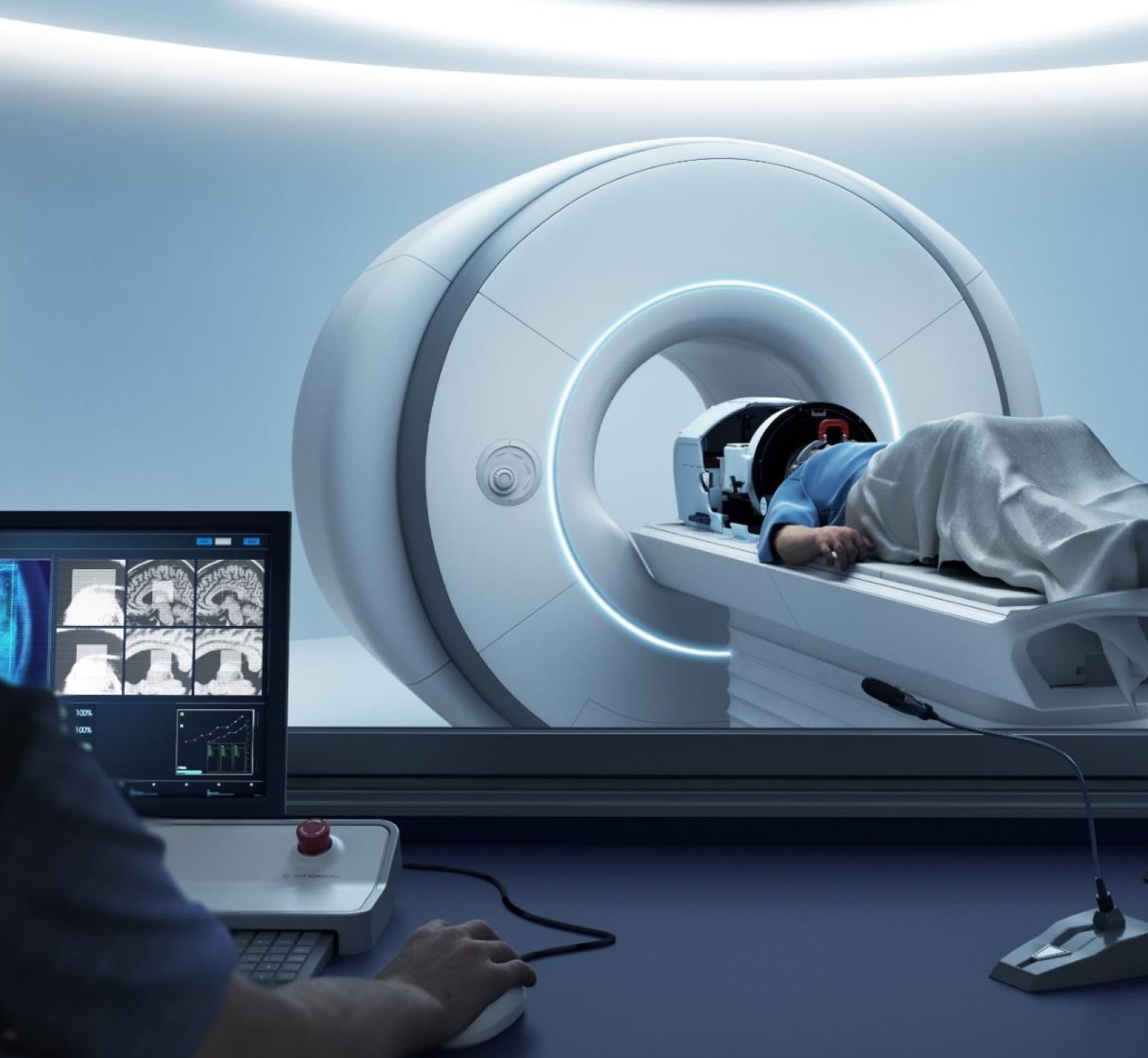
Focused ultrasound is an incisionless functional neurosurgery option for selected patients with disabling tremor. Under MRI guidance, multiple ultrasound beams pass safely through the skull and converge on a small target in the tremor circuit. Where the beams meet, the energy creates a focused thermal lesion intended to interrupt abnormal tremor signaling.
For tremor, the usual target is the ventral intermediate nucleus region of the thalamus, a target also used in deep brain stimulation and traditional thalamotomy. The major difference is that focused ultrasound does this without an incision, implanted lead, battery, or ionizing radiation.
Conditions it may help
- Essential tremor that interferes with writing, eating, drinking, or work
- Parkinson’s tremor that remains disabling despite medication
Essential tremor can make basic activities difficult: writing, signing checks, eating soup, drinking from a cup, using tools, applying makeup, or working with the hands. Many patients respond to medication, but some do not get enough benefit or cannot tolerate side effects.
Focused ultrasound is not a general Parkinson’s treatment. It is considered for selected patients when tremor is the symptom being targeted.
How it fits into treatment planning
Focused ultrasound is one option among several. Some patients are better candidates for deep brain stimulation (DBS), especially when symptoms affect both sides, when adjustability is important, or when symptoms beyond tremor need to be addressed. Others may prefer an incisionless option if their anatomy and goals fit.
Who may be suitable
Evaluation includes confirmation of the diagnosis, review of medication response, neurologic examination, imaging, and discussion of treatment goals. Candidacy also depends on technical and safety factors, including:
- MRI compatibility and ability to tolerate time in the scanner
- A screening CT to assess skull characteristics and whether ultrasound energy can be delivered effectively
- Tremor pattern and whether the main disability is one-sided or bilateral
- Whether the target can be reached safely
- Medical conditions, medications, and bleeding risk
- Ability to remain awake enough to communicate sensations during treatment
- Realistic goals for tremor reduction, balance, speech, sensation, and independence
Focused ultrasound is usually planned for the side of the brain that treats the more disabling hand tremor. Second-side treatment is a separate decision and is generally staged after the first treatment has had time to declare its benefit and side-effect profile.
How treatment day works
Treatment day sequence
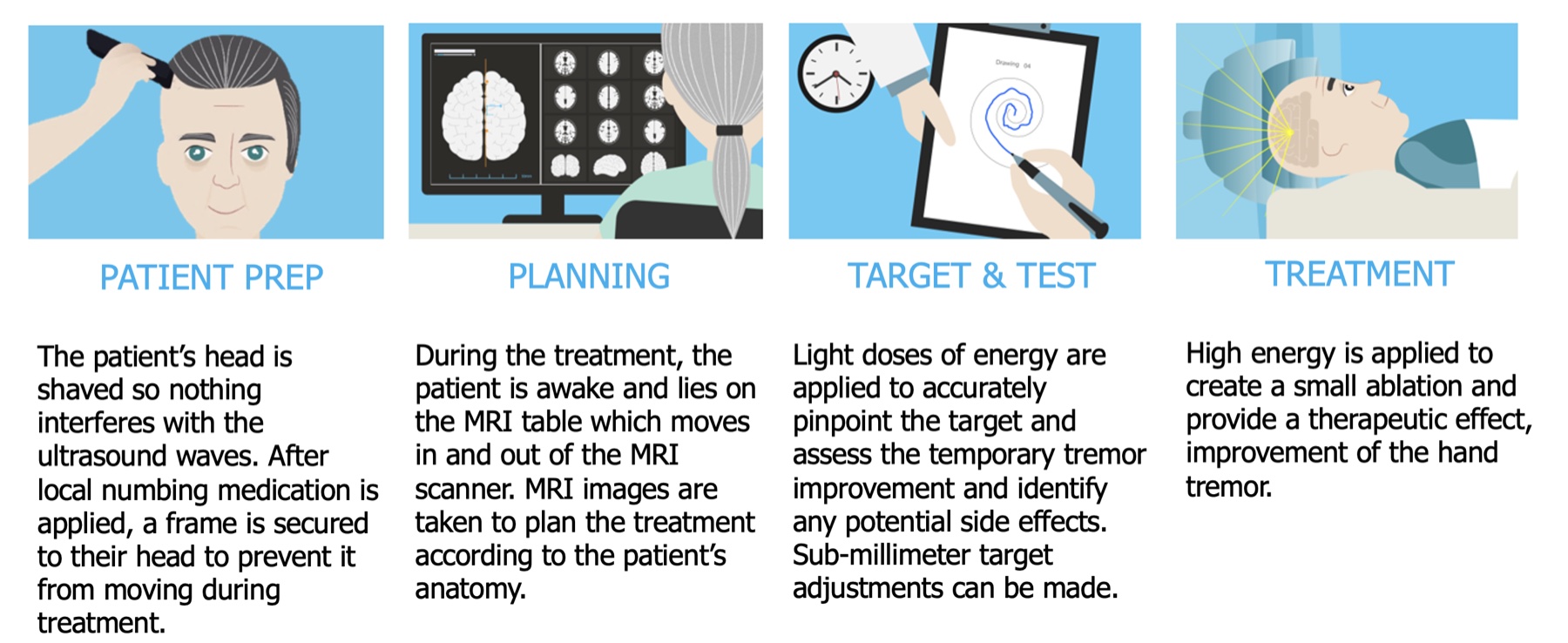
The treatment is performed in an MRI environment. The details vary by center and patient, but the sequence usually includes:
- Preparation: The scalp is prepared so ultrasound energy is not blocked. A stereotactic frame is placed with local numbing medication to keep the head still.
- MRI planning: The patient lies on the MRI table with the head positioned in the focused ultrasound helmet. MRI images are used to plan the target around the patient’s anatomy.
- Target testing: Low-energy sonications are used first. The team checks temporary tremor improvement and watches for side effects such as tingling, imbalance, speech change, or weakness.
- Treatment sonication: Higher energy is delivered only after the target is confirmed. MRI thermometry monitors temperature in real time.
- Recovery and discharge: Many patients go home the same day after observation, with follow-up to monitor tremor response, balance, sensation, and function.
What benefits are realistic
Many patients experience tremor improvement during the procedure because the team can test the target while the patient is awake. The goal is meaningful improvement in the hand tremor that interferes with daily life, not a guarantee that all tremor disappears.
Longer-term clinical data in essential tremor support durable benefit for many selected patients, including five-year follow-up data for first-side treatment. The same data also show why careful counseling matters: numbness or tingling, imbalance or gait disturbance, headache, taste change, speech change, weakness, or coordination problems can occur, and some symptoms may persist.
Second-side treatment
Focused ultrasound is usually considered first for the hand that causes the greatest disability. For many patients, that means treating one side and following the response before making any decision about the other side.
Second-side treatment may be considered for selected essential tremor patients when the untreated side remains disabling and the first side has produced a durable benefit without concerning side effects. This is a separate decision, usually staged months later, because bilateral lesioning can increase the importance of speech, balance, sensation, swallowing, and coordination risks.
The discussion should include the patient’s day-to-day priorities, fall risk, speech demands, occupation, dominant hand, prior response, and whether DBS would offer a better balance of bilateral control and adjustability.
Focused ultrasound vs DBS
Focused ultrasound and DBS can both target tremor circuitry, but they solve the problem differently.
- Focused ultrasound: incisionless, no implanted device, no battery, usually outpatient, but creates a permanent lesion and is not adjustable after treatment.
- DBS: adjustable and programmable, can be used for bilateral symptoms in selected patients, and can be adapted over time, but requires implanted hardware and long-term device management.
The better option depends on diagnosis, age, medical risk, symptom pattern, whether both sides are affected, need for adjustability, tolerance for implants, imaging anatomy, and patient goals.
Coverage and practical planning
Insurance coverage depends on diagnosis, laterality, plan rules, and site-specific requirements. Patients should verify benefits with their insurer before treatment. The office can help clarify what records are needed, but coverage decisions are ultimately plan-specific.
At Houston Methodist, the goal is to make the first focused ultrasound visit as comprehensive as possible. When feasible, the visit is coordinated so the necessary imaging, skull-density screening, and neurology assessment if needed can be completed the same day, helping patients leave with a clearer sense of whether focused ultrasound is technically possible and clinically appropriate.
Dr. Barone’s approach
Dr. Barone evaluates focused ultrasound in the context of the full functional neurosurgery toolkit. The goal is not to push every tremor patient toward the same procedure, but to compare focused ultrasound, DBS, medication adjustment, and observation around the patient’s anatomy, symptoms, risk tolerance, and priorities.
Focused ultrasound webinar
Focused ultrasound for essential tremor and Parkinson's tremor
In this webinar, Dr. Barone discusses MRI-guided focused ultrasound, how it fits into tremor treatment planning, and how it compares with options such as DBS for selected patients with essential tremor or Parkinson's tremor.
Frequently asked questions
What is focused ultrasound for tremor? +
Focused ultrasound uses MRI guidance and concentrated ultrasound energy to create a precise lesion in a tremor circuit, usually the Vim region of the thalamus for tremor. It does not require an incision or implanted device.
Who may be a candidate? +
Focused ultrasound may be considered for selected patients with disabling essential tremor or Parkinson's tremor that has not responded adequately to medication. Candidacy depends on diagnosis, imaging, skull characteristics, ability to tolerate MRI, symptoms, and treatment goals.
How is focused ultrasound different from DBS? +
DBS is adjustable, reversible, and can treat both sides in selected patients, but it requires an implanted device. Focused ultrasound is incisionless and does not require an implant, but it creates a permanent lesion and is typically used for one side. The best choice depends on the patient.
Is focused ultrasound usually done while awake? +
Yes. Patients are typically awake enough to communicate during treatment so the team can test tremor response and monitor for temporary side effects such as numbness, tingling, imbalance, or speech changes.
Can both sides be treated? +
Focused ultrasound is most often used for the dominant or more disabling side. Second-side treatment may be considered in selected essential tremor patients, usually as a staged decision after the first side has been followed over time.
Considering treatment for Focused ultrasound for tremor?
Dr. Barone evaluates new patients and referrals at Houston Methodist Hospital, Houston. Patients from outside Houston, across the United States, and internationally are welcome.